
This is part one of a two-part series, which discusses the historical context and evidence we have for the cut and construction of hose. Part two, on the actual reconstruction process, is forthcoming.
Context
Hose cover the legs, and differ in coverage and tightness across the centuries and according to the wearer’s social status. In the later medieval period, men’s hose were suspended from the doublet with laces, or “points”.
By the late 1460s/ early 1470s, which is the time frame I focus on, separate hose for the middling sort and elites were a rarity, and were primarily worn by labourers and those engaged in physical activity. Separate hose have two distinct legs that do not connect to cover the buttocks completely, or a codpiece to cover the crotch. As such, they can be rolled down (as in the middle image) when it’s hot, or when doing heavy labour.
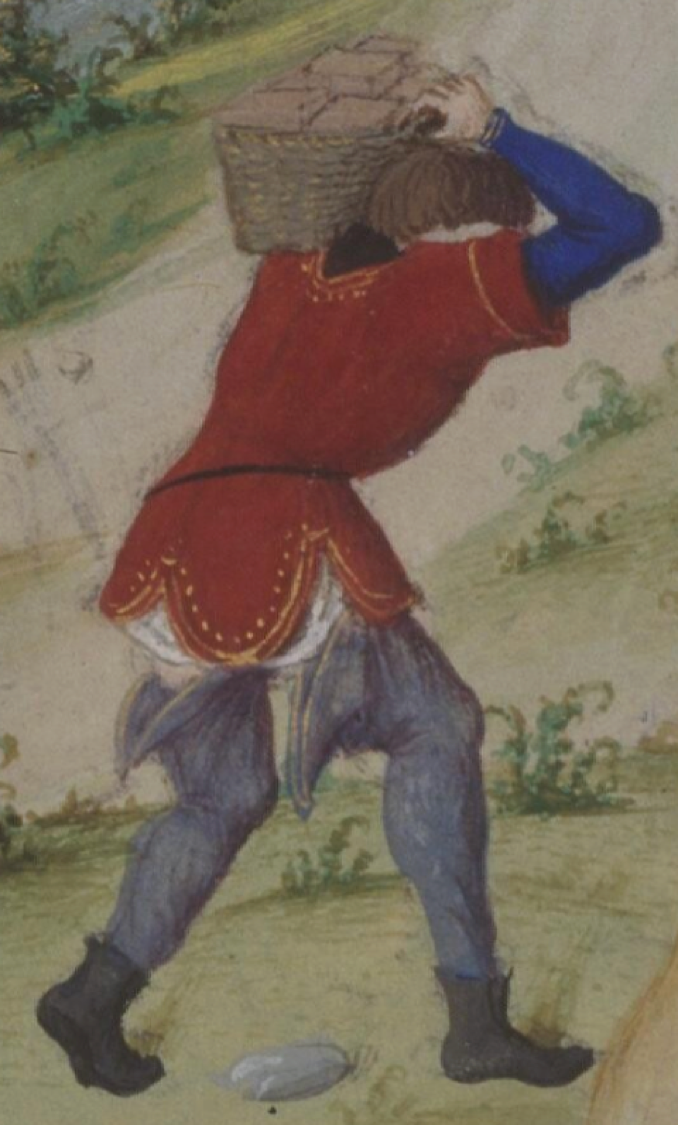
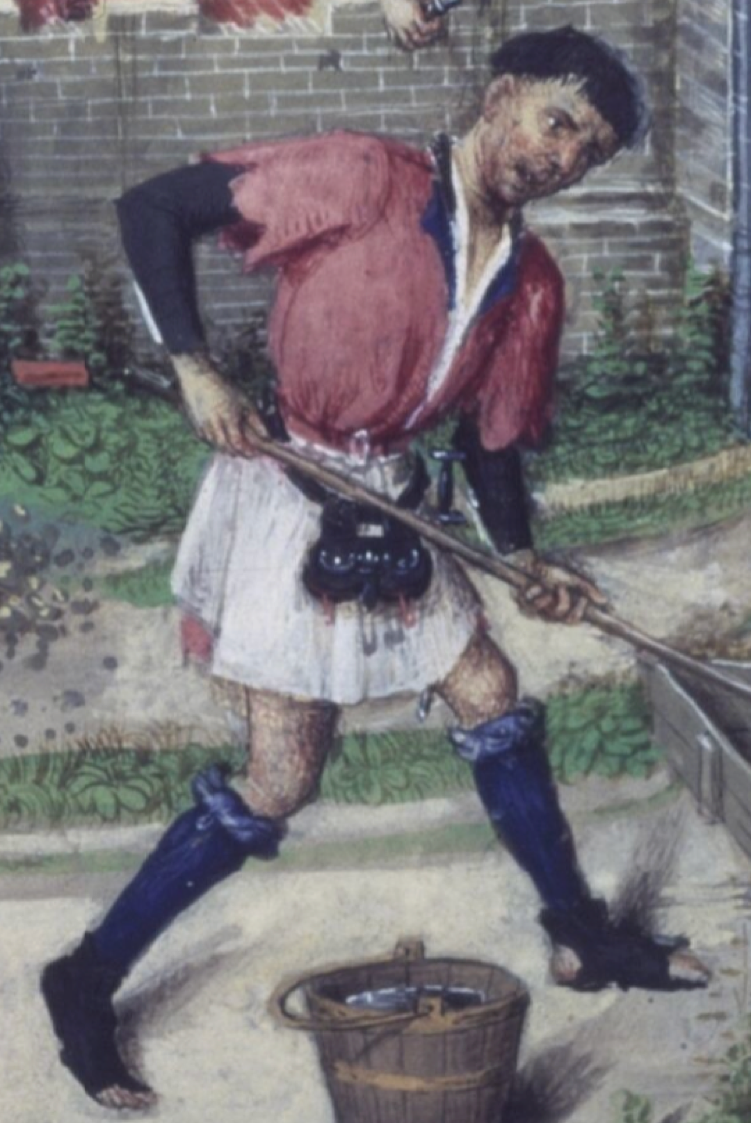
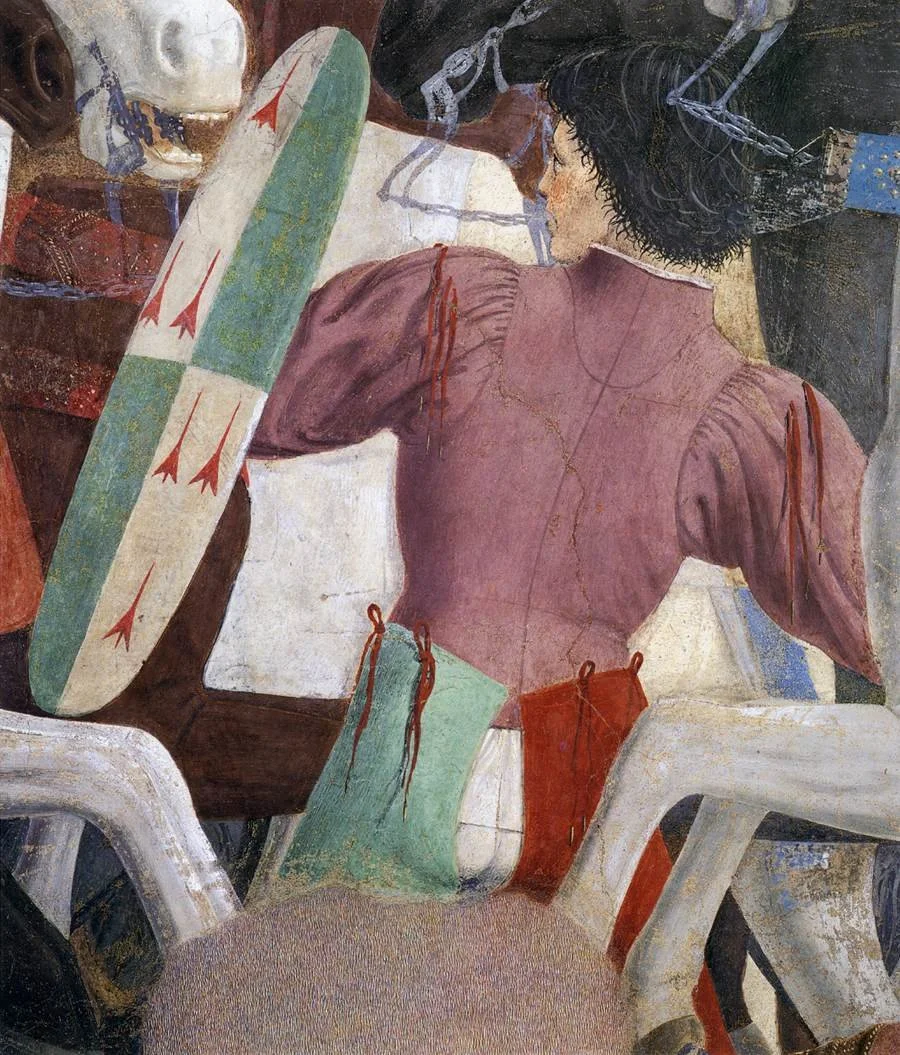
Joined hose were instead far more common, if not universal, for men’s dress in the court of the Burgundian dukes. They permitted more modesty, especially given the fashion of rising hemlines on pleated jackets, scandalising some clerical writers for their exposure of the buttocks and “the location of their humanity” (Du Clercq, from van Buren, 2011: 205). Fashionable hose also tended to be as tight and wrinkle-free as possible - to show off the form beneath, the lack of need for physical exertion that would risk ripping the tight hose, and the expertise of the hosier in fitting them.
Triangulating the Evidence △
Archaeological evidence
Pattern
We tend to find scraps from the feet of hose in the archaeological record rather than part from the leg or hose in their entirety, presumably because larger bits of fabric from further up the leg tended to be salvaged for other purposes. Extant remnants of fifteenth century hose are a rarity, and finds are typically dated either side of this century. I was able to research 14th century hose from London (England), and sixteenth century hose from Groningen (the Netherlands), Alpirsbach (Germany), and London again. I’m also aware of fourteenth century finds from Lübeck (Germany), discussed by Jaacks in 1993, and late sixteenth century finds from French and Spanish whaling settlements in Labrador (Canada), discussed in Dubuc in 1990; but unfortunately was unable to obtain copies of these articles.
The various 14th century hose and the Finsbury hose discussed in Crowfoot et al. were cut on the bias for maximum stretch (2001: 185), as were the Alpirsbach finds (Fingerlin, 1997: 103, 117). The Groningen finds were also cut on the bias, and were often pieced at an upper corner for economy of fabric (Zimmerman, 2004: 160). All hose that I am aware of are closed by a seam running up the back of the leg.
There is great variety in how the hose were patterned to cover the feet in the archaeological record, and Crowfoot et al. (2001: 188) and Staniland (1997: 246) both point to a growing sophistication in the cut and construction between the fourteenth and sixteenth centuries. Some hose didn’t enclose the foot and instead just had a strap of cloth going under it like a stirrup, but these aren’t my focus at this point in time. The 14th century London finds show a variety of patterning techniques, most involving ‘the continuation of wedge-shaped sections over the ankles and heel’, or sections covering the instep and front of the foot like ‘broad tongues’ (Crowfoot et al., 2001, 189-90). From previous experiments with this earlier style, I know I hate the sensation of seams underfoot, so I’ve primarily recreated hose where the sole mirrored the outline of the foot and triangular gussets were inserted on either side at the ankle.
In my research however, another version of this style caught my eye. It is seen in two sets of sixteenth century finds, one from Finsbury, London, in Textiles and Clothing (Crowfoot et al, 2001); and the others from Alpirsbach. The relevant Alpirsbach finds were discovered in 1958 and consist of: a pair of joined hose dated to 1490-1535, the soles of which have not survived (Fingerlin, 1997: 104); and several short hose and ankle socks (used as insoles), presumed to belong to schoolboys dating to the second half of the 16th century after a monastic school was established in the recently-closed Abbey (1997: 116, 100). The Finsbury hose and the Alpirsbach short hose have ankle gussets, but do not have an “outline” sole. Instead, there is a triangle cut-out at the ball of the foot that is filled in by the back seam of the hose extending over the heel.
Zimmerman examined finds from Groningen dated approximately 1577-1600, 54 of which she determined were complete or fragmentary hose. 27 of these had identifiable sole shapes, which she grouped into five shapes. Interestingly, none of these were the cut-out style seen in the Finsbury and Alpirsbach hose. The greatest proportion of identifiable sole shapes (almost half, at 12) simply followed the outline of the foot. However, 5 of the 27 hose have the triangle cutout of the Finsbury and Alpirsbach hose in reverse, where the one-piece sole either has a flared two-piece extension like a fishtail that joins to form a point, or a one-piece triangular extension, both of which extend into the back seam (2004: 161). I believe that these three variations serve a similar purpose, in allowing for reduced bulk and greater shaping around the heel and ankle, giving ‘the heel covering a well-rounded shape’. Zimmerman also notes that there was an abundance of piecing to allow for the fabric to be cut as economically as possible. Smaller pieces like piecings, soles and gussets were often cut on a different grain from the rest of the hose, or from a different fabric (or weave) entirely (2004: 162). She also found that ‘the [ankle] gussets of no two hose were identical’ (2004: 161), suggesting these were individual to the wearer.
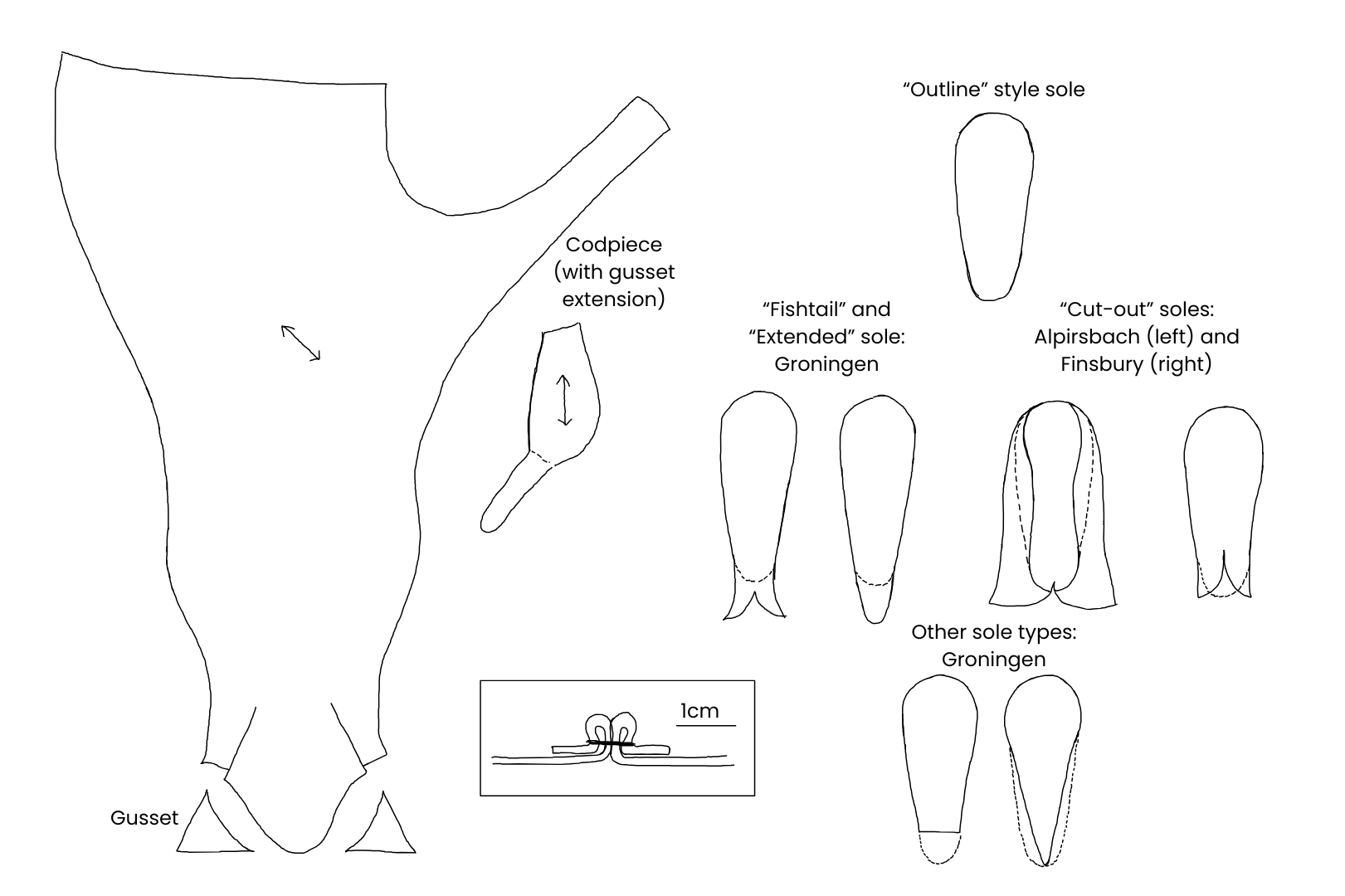
Approximate medieval hose pattern for “sole and wedge” style (left, modified from Thursfield, 2015: 84-6 figs. 6.17, 6.18, 6.20); with sole style options from various archaeological finds (right). Groningen soles from Zimmerman (1997: 161 fig.3); Alpirsbach modified from Fingerlin (1997: 118 fig.26) and Finsbury modified from Crowfoot et. al (2001: 189 fig.169). Inset is back seam construction style from Zimmerman (1997: 161 fig.2).
As a brief aside - it should also be noted that we often see depictions of people just wearing hose and no shoes, including in outdoor settings. This is because some cloth hose had leather soles attached. This would obviously work best with sole styles that replicate the outline of the foot, to prevent areas where cloth would be exposed to the ground.
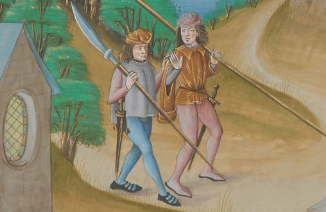
Soled hose (chausses semelées) turn up in account books from the 14th and 15th centuries (see Gay and Stein, 1887: 354). There don’t appear to be any leather remnants or evidence of removed additional soles in archaeological finds of hose, but it could be that these are hard to distinguish from finds of actual shoe soles.
This manuscript illustration (detail from BL Royal MS 18 E V, Chronique de Baudouin d'Avennes, 1473-1479, f.111r) is the clearest depiction I’ve found of hose with a separate sole.
Materials
In terms of fabric, the Finsbury hose were made from a worsted wool 2/2 twill, compared to the tabby-woven cloth of 14th century London finds. Twill cloth provides more strength and elasticity than tabby cloth, and as such ‘had become the preferred material for hose by the 16th century’ (Crowfoot et al., 2001: 190, 186).
The sixteenth-century Groningen finds discussed by Zimmerman (2004: 161) were similarly all made of wool, mostly in a coarse, plain weave with 6-12 threads per centimetre and often napped on one or both sides. There are hose made from a ‘coarse 1/2 twill’ as well as a ‘thin, supple 2/2 twill’, in which the Z-spun warp varies from 18-24 threads per cm, and the S-spun weft 14-26 pcm. The soles are also reported as often being of a thicker fabric than the rest of the hose.
One of the textile fragments from Moorfields, presumed to date from the mid-sixteenth century, is a medium weight 2/2 twill wool woven from S-spun yarn with 12 threads per cm (warp and weft) that Cubitt et al. say ‘compares closely’ to cloth used for hose in other contemporaneous finds (2019: 236).
The Alpirsbach hose are unusual in that they are made of linen, which does not have as much natural stretch as wool. The joined hose are made of a three-shed twill (Fingerlin, 1997: 103) and the short hose of a mix of plain and twill weaves. The toe caps and soles of at least one of the short hose are made of coarser linen than that of the leg and gussets, to help prevent wear (1997: 117).
Construction
Crowfoot et al. suggest that the main back seams of the extant hose found in London and dating to the 14th century could have been backstitched to provide additional strength to the seam and prevent it coming apart in use. The seam allowance of the back seam was opened out and stitched down with a running stitch 2-3mm away from the seam and parallel to it (2001: 156). Interestingly, this seam finishing was worked from the outside, making the stitches visible when the garment was worn. If the stitches were worked from the inside, it would be possible to make shallow stitches that catch the underside of the wool but do not pierce all the way through the fabric, leaving little divots but not showing the thread. The authors compare this technique with the seams of the dress associated with Queen Margareta in Uppsala Cathedral, where it is used to help the seams lie flat (2001: 187-18). The seams at the foot of the hose were lapped, with an overlap of 4-7mm. This flatter style of seam is more comfortable under the foot, and Crowfoot et al. also suggest that they may be felted together over time by ‘the heat and dampness of the human foot’. The stitches were approximately 3mm long, at 3-4mm intervals, and consisted of ‘a fairly upright hem stitch’ (2001: 190, 153-5). Two fragments of bias cut cloth likely to come from hose suggest that one possible finishing method for the top edge was a single-fold hem of 4-5mm, held by backstitching in silk thread about 2mm from the edge (2001: 187).
Of the Groningen hose fragments, the plain weave finds were predominantly stitched with linen, and the finer twill with silk. In one case, there is evidence of silk and linen thread being used in the same seam. The back seams are unusual in that they used a running stitch worked through a double layer of cloth (i.e. four layers total) for additional strength (see inset in pattern diagram above). This is done by turning back the seam allowances about a centimetre (often narrowing above the heel) before sewing together. The gussets are described as having ‘usually a single (but sometimes a double) row of thread impressions a few millimetres from the edge’, and ‘often…impressions of overcast stitching’. I interpret this as lapped seams, but could be misunderstanding. Some of the gussets also had decorative top-stitching in silk. Zimmerman also reports that some of the hose fragments have evidence of additional seams around the forefoot and in the gussets, and these are likely darts to improve the fit (Zimmerman, 2004: 160-2). She also posits that the Groningen hose, particularly those made from coarser weaves, and/or those with a greater number of repairs, were likely sewn at home rather than made by members of the Tailors’ Guild (2004: 164).
The Alpirsbach hose are a rare survival of relatively intact joined hose, but unfortunately construction details in the archaeological report are limited. Figures of the conserved hose show that the rear seams continue vertically up to the top band (1997: 101). They also differ from conventional hose construction in two main ways. First, they lack eyelets for lacing, and so Fingerlin they were work trousers (1997: 106). The other interesting thing to note is that the top corner of the codpiece was sewn to the hose on one side, but attached by eyelets on the other, rather than only being connected to the body of the hose at the base as more commonly seen in portraiture (1997: 102).
Documentary evidence
Sturtewagen’s 2016 thesis analyses the clothing of the people of Bruges between the fifteenth and sixteenth centuries, and is a fantastic collation of documentary evidence for my purposes. She examined 104 records from 1437-1480: 69 bastaardgoederen (inventories of Bruges burghers of illegitimate birth, found in the General State Archives of Belgium) from 1437-1444; and 33 confiscation inventories from the deanery of Sint-Donaas dated between 1460 and 1480, kept in the State Archives in Bruges. The after-death inventories are approximately 51% lower class, 36% middling and 13% elite, while the confiscation records were estimated to be 6% lower class, 61% middling, and 33% elite (2016: 271, 274).
She goes on to break down lower garments mentioned in inventories, where specified, by fabric and by colour. For the bastard inventories (reminder: 1437-1444, predominantly lower class), the fabric percentages were approximately 40% laken (i.e. broadcloth), 40% light woollen, and 20% non-silk mixed weave (2016: 287). Where colour was mentioned, approximately 30% of lower garments were black, just over 20% were shades of red, just under 20% blue and just under 20% grey. Just over 5% were green, and the remaining proportion (under 5%) were white (2016: 291). For the confiscation inventories (reminder: 1460-1480, predominantly of the middling sort), 66% were of light wool cloth, and 33% were of leather (2016: 287). In terms of colour, just under 60% were black, just under 25% were grey, just over 10% purple, and about 5% were tawny (2016: 291). So overall, we see a trend towards hose made of light woollen cloth, and a greater propensity for black hose.
Sturtewagen also discusses a source that specifies a construction style for hose: Zegher van Male’s Spieghel Memoriael was written c.1550 as a guide for future governors of the Bruges Beghard school, and discusses clothing for the school’s pupils. They wore knee-high stockings, made of kersey (2016: 226-7). Van Male specifies that ‘the hose for the children should be made using a pattern that has no seam running under the sole of the foot’, because this was “very unpleasant for the children to wear”. These were referred to as ‘coussins [hose] met zuelen ende clyncken (with soles and wedges)’ (2016: 229). This is the style I lean towards, for the same reasons, and it was so endearing to see this concern for the children in his care from a man centuries ago.
The 1455 statutes of the hose-makers in Dijon tell us that they “shall be required to make their hose for sale of good, sound and marketable cloth; well soaked, scoured and fulled, so as to cut them and make true and straight bias cuts without twisting; …to supply them with new, suitable cloth, without including any pieces of old cloth or any colour other than that of the main body of the hose; and where they are lined with canvas, it shall be entirely new, sound and of merchant quality, and sufficiently white.” (Beaulieu and Baylé 1956: 43 n.1).
Several secondary sources suggest that perpignan (a light, semi-worsted, serge-woven 2/2 twill wool fabric originiating in Perpignan, France) was particularly popular for the making of hose (see Frick, 2002: 167 n51 and McCall, 2022: 144), but I was unable to indications of this in sources specific to Burgundy. Though if it was popular in Italy, it stands to reason that it would also be popular in France and Burgundy, particularly given its original production location.
Pictoral evidence
As with doublets, a full depiction of hose (i.e. not covered by outer clothes) is generally reserved for those engaged in physical activity. When it is not covered by outer garments, we are more likely to be able to see the codpiece style, the closing seams over the seat, and/or the approximate numbers of eyelets used to suspend them from the doublet.
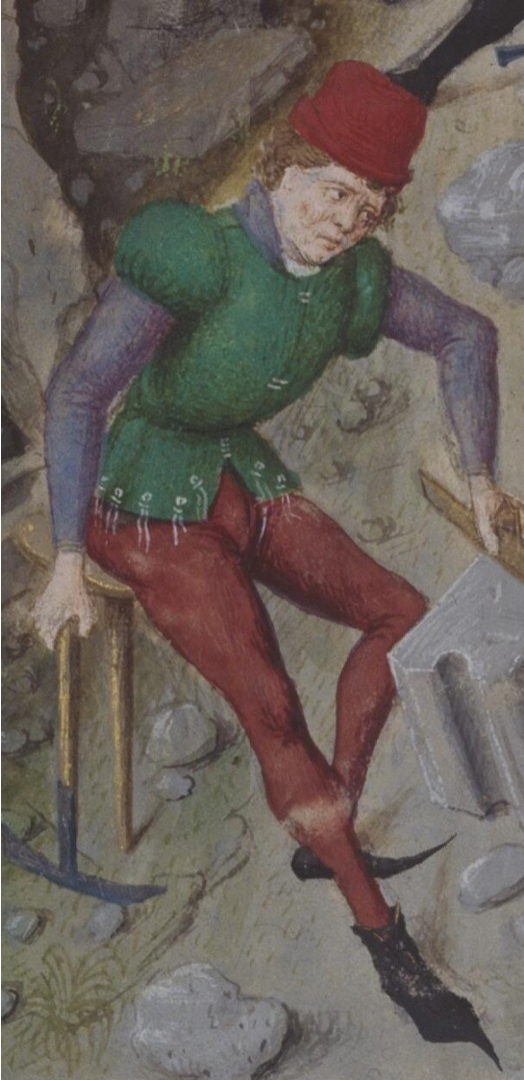
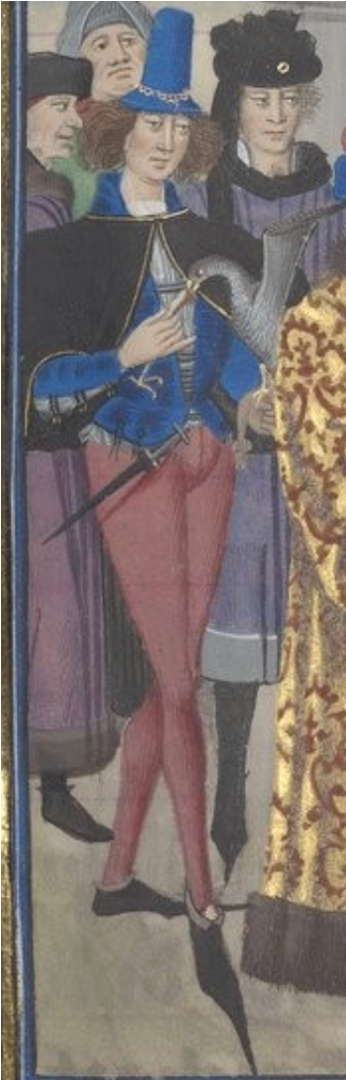
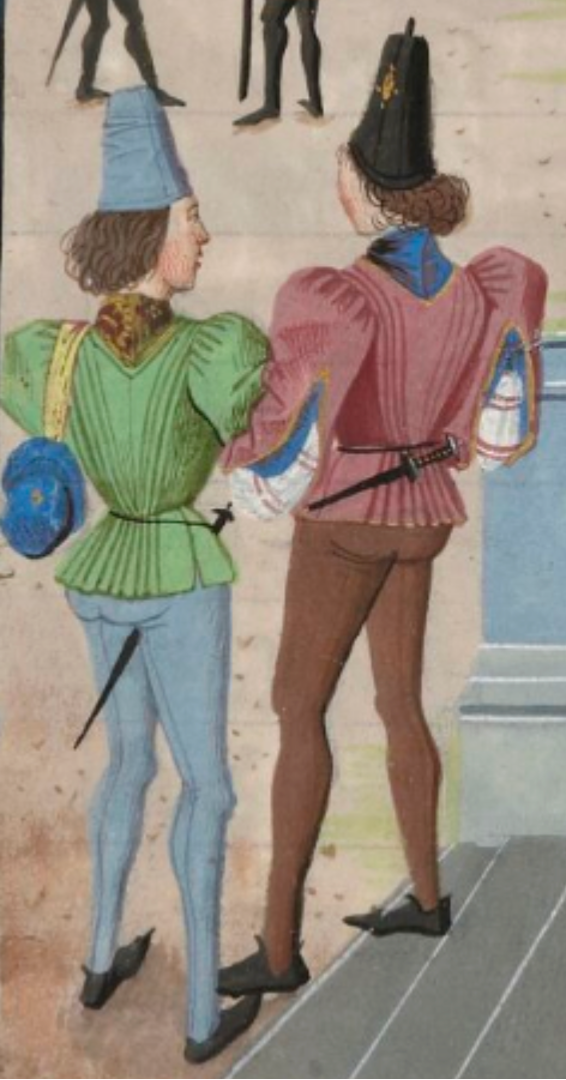
Artists did not always choose to include details such as seams on hose, and as ever, stylistic choices must be balanced with the likelihood of an accurate representation of the historical reality. While a skin-tight fit can be achieved with woollen hose cut on the bias, depictions that do not show a little bagginess around the knees and seat to account for movement are unlikely to be realistic in that respect.
I also chose images that show hose in lighter-coloured fabrics, as these typically included more detail. However, as we have seen in the documentary evidence discussed above, hose came in a range of colours. Black was a particularly popular choice for illustrating hose of the later fifteenth century, as were pinks and reds. Also seen are blues (particularly a blue-grey), greys, greens and browns. Hose are almost always shown as a solid colour rather than mi-parti. A notable exception to this is the executioner in Dieric Bouts’ painting Justice of Emperor Otto III: Beheading of the Innocent Count (c.1473-5) in blue and yellow joined hose. I also found mi-parti green and white hose on a figure in the foreground on the right of Jean Fouquet’s The Trial of the Duke of Alençon (c.1459) (potentially a foreigner based on the style of his hooded cloak); and green and yellow hose on an executioner in Faits du Grand Alexandre (BnF Français 22547, 247r) - mi-parti hose could therefore have a connotation of livery rather than typical wear at this point in time.
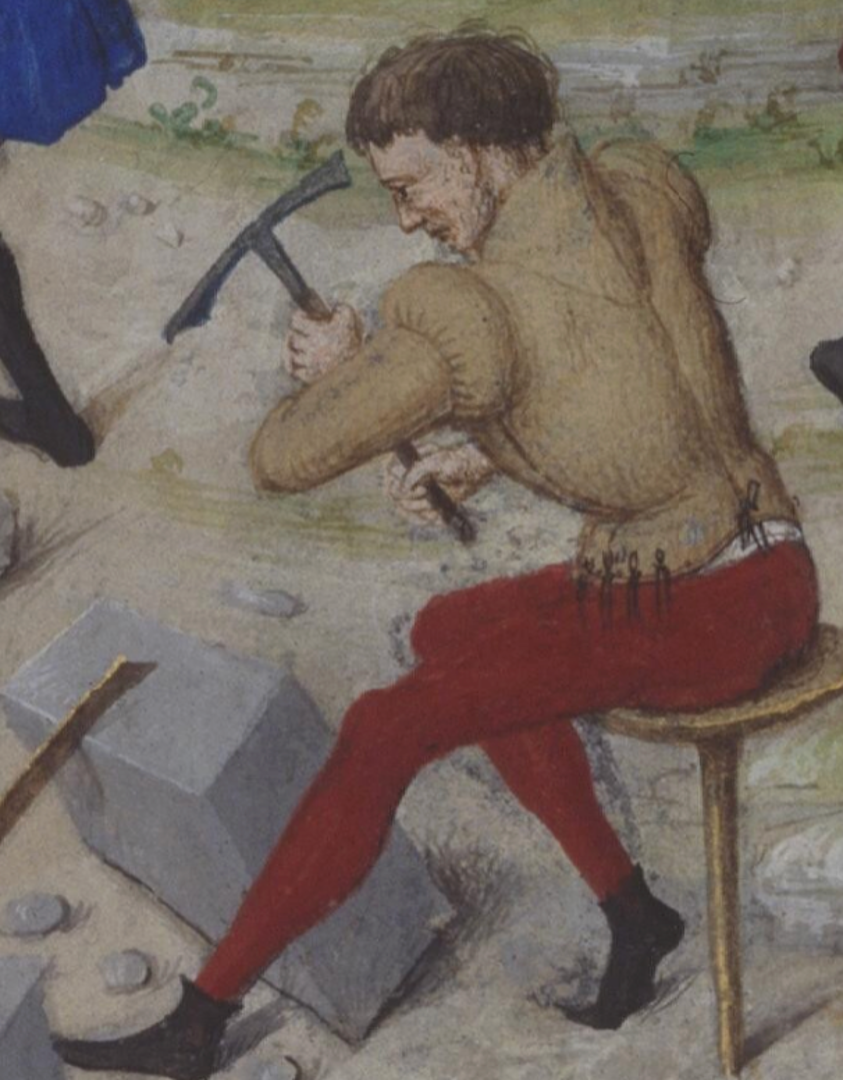
Right: ONB Cod. 2533, fol.17r: Les Chroniques de Jérusalem abrégées: The Fortification of Jaffa
Hose are shown to be low rise, not extending much higher than the widest point on the hips, with a flap-style codpiece rather than the shaped styles of the sixteenth century. Footed hose often mimic the long piked toe fashionable in shoes at the time, which served to elongate the figure.
Numbers of points, assuming an equidistant spread, ranged from approximately 7 to 15. However, some of the stonemasons in the illustrations in Les Chroniques de Jérusalem abrégées (ONB Cod. 2533, fol. 12v and 17r) are shown to have more points at the front than at the back: this person on the right has four points at the front and side, one empty set of eyelets, and then a gap until a final set of points at centre-back, totalling approximately 11 if all sets of eyelets are used.
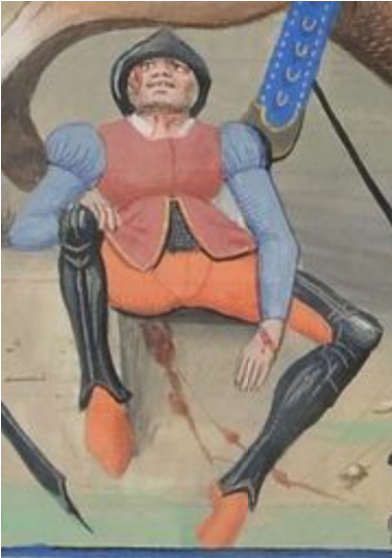
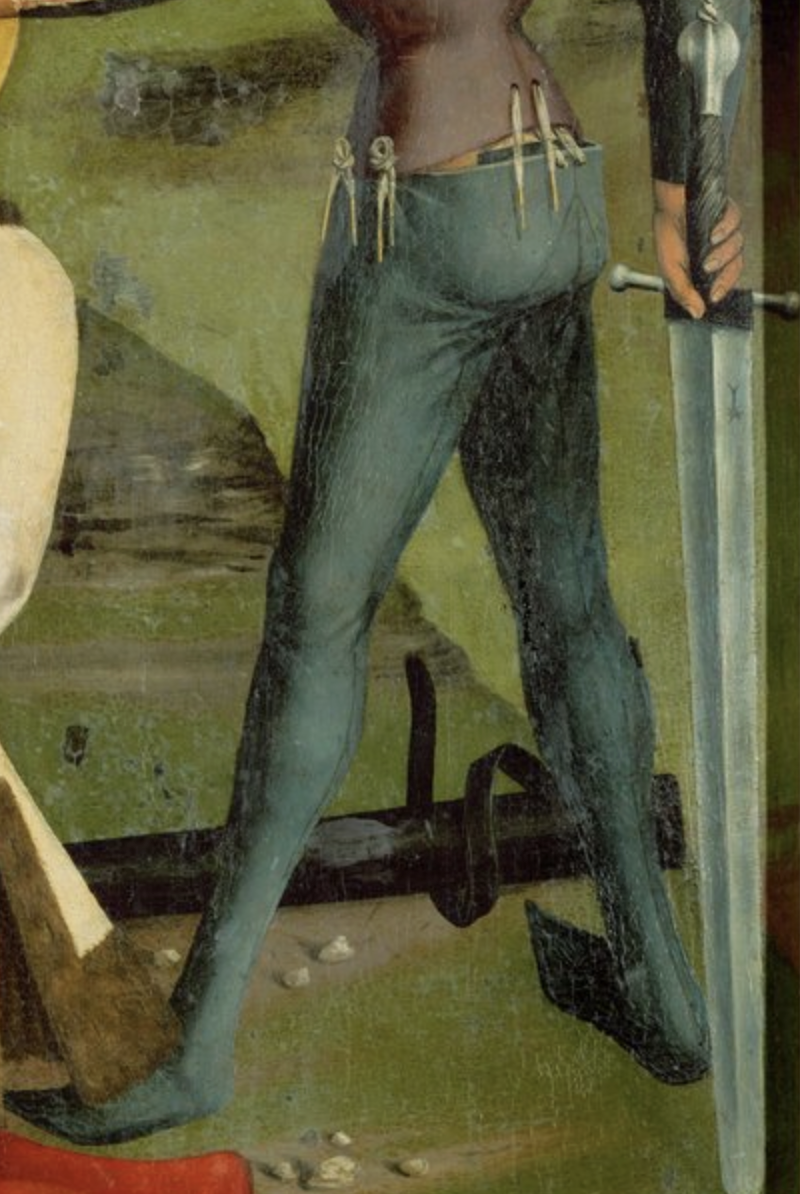
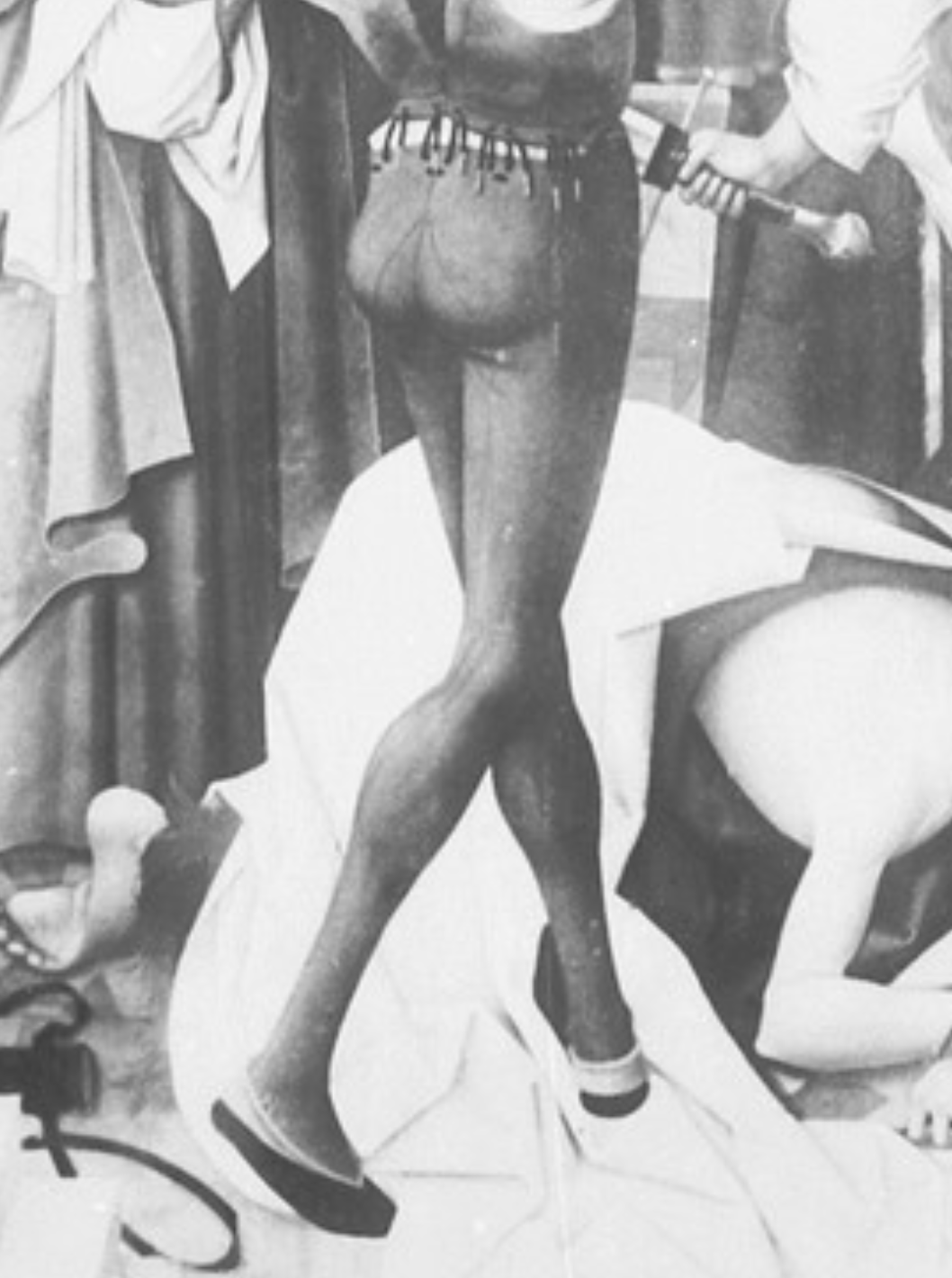
Hose are shown to be closed at the back of the leg. I have not found clear Franco-Flemish depictions of how the legs of joined hose were joined at the seat, so have had to look elsewhere. The illustration of the injured soldier (above, middle right) does suggest that the codpiece extended between the legs to serve as a gusset.
These two German paintings depicting The Beheading of St George (below, left) and the Beheading of John the Baptist (below, middle) show a triangular seam, whereas the Italian fresco depicting the Martyrdom of Saint Bartholomew (below, right) shows a more vertical seam like those of the Alpirsbach joined hose. It may be down to regional difference, personal preference of the wearer or tailor, or practical concerns for getting the best fit depending on the wearer’s body type.
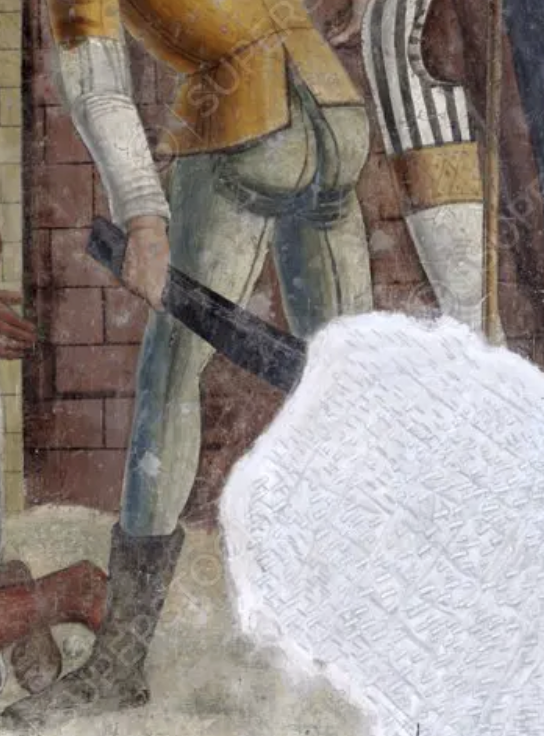
Another interesting thing to note for Burgundian depictions of hose in the fifteenth century is that they aren’t shown being held up at the calves by garters, regardless of social class or activity. Whether this was a stylistic choice by the artists or a reflection of reality is hard to tell.
Embroidered hose
There are numerous depictions of what appears to be goldwork embroidery on hose, which I fell down a rabbit hole on and honestly deserves a post of its own. The designs are typically on the upper thigh or below the calf of one leg and range from simple to elaborate.
I predominantly found them depicted in two manuscripts: Croniques abregies commençans au temps de Herode Antipas (vol.1: BnF Ms-5089 réserve; vol.2: BnF Ms-5090 réserve, c.1462) and Faits du Grand Alexandre (BnF Français 22547, 247r, c.1470). The latter is illuminated by Loyset Liédet, and the former’s illuminator is unknown.
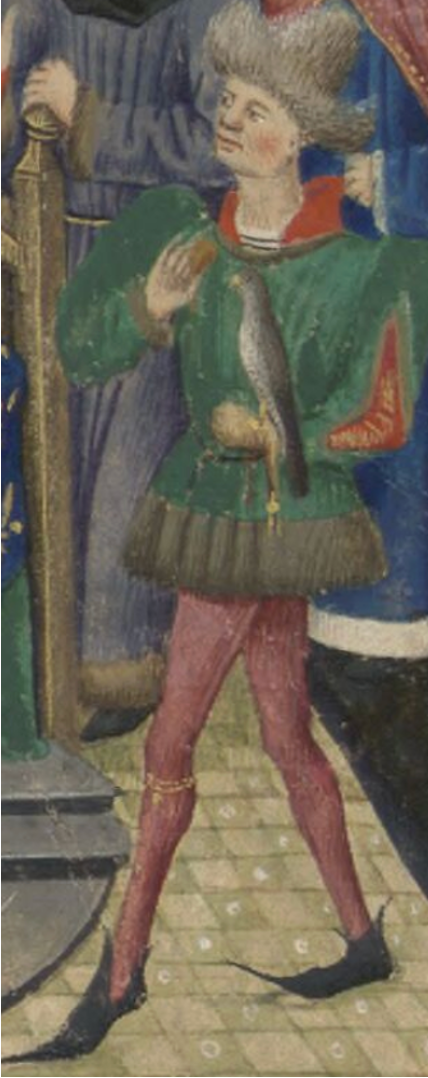
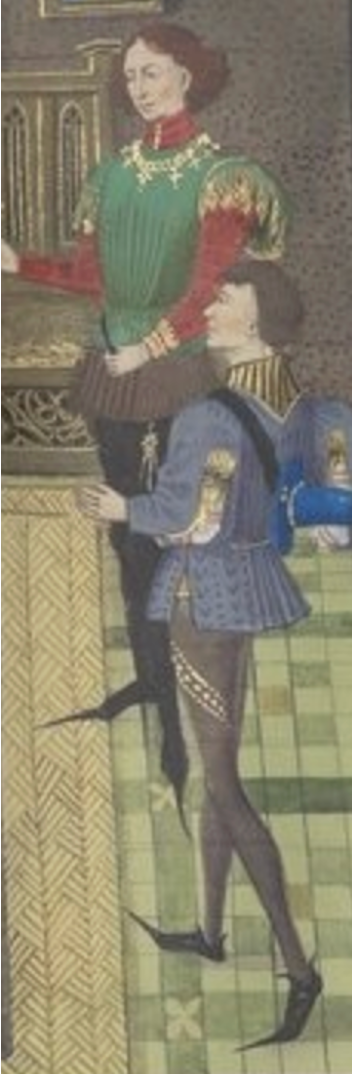
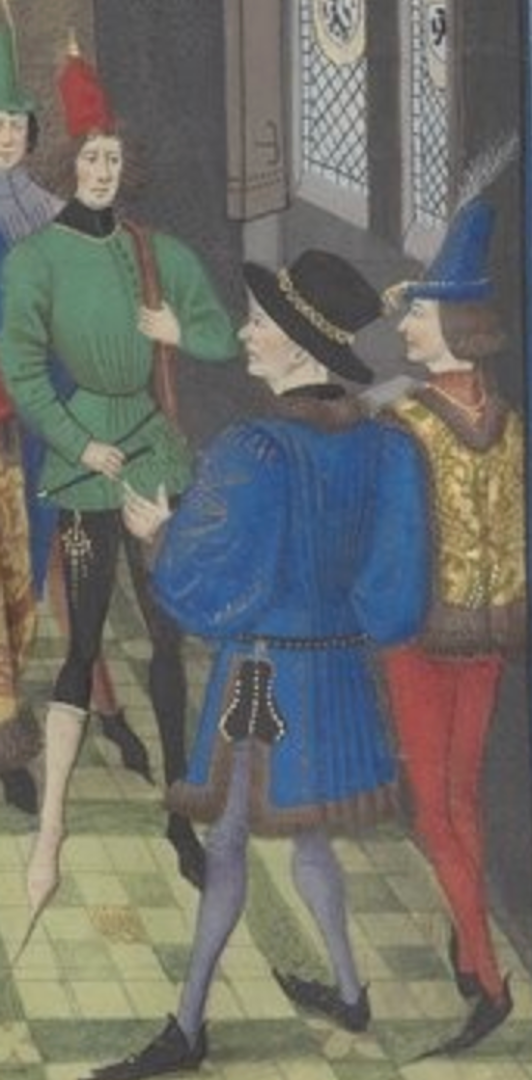
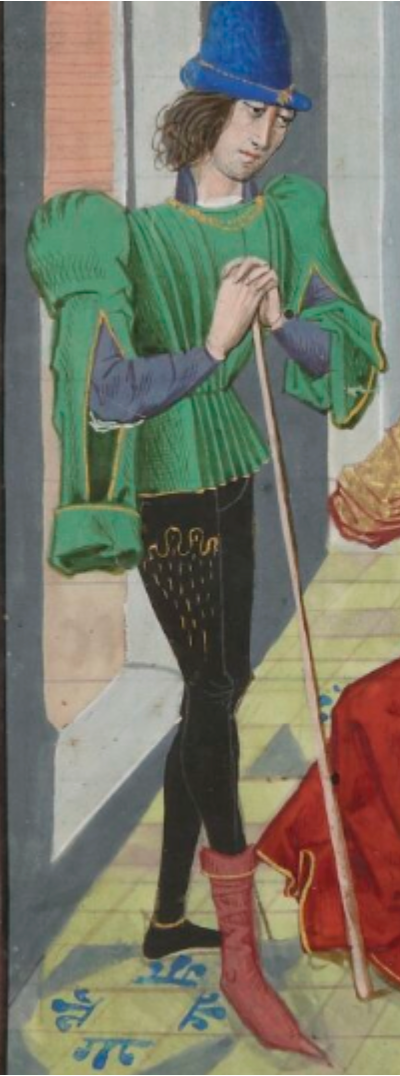
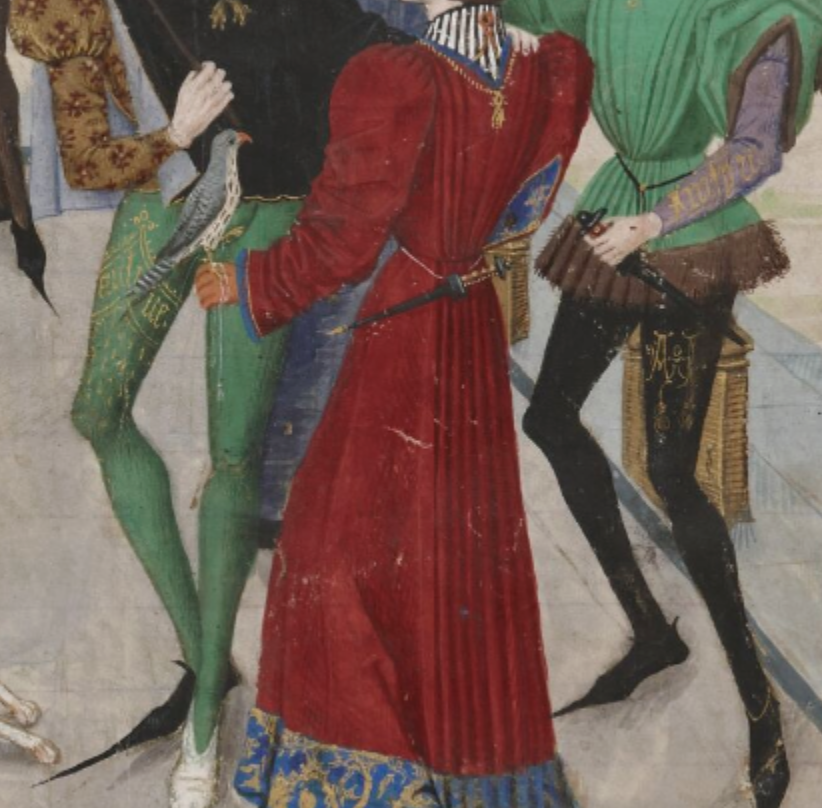
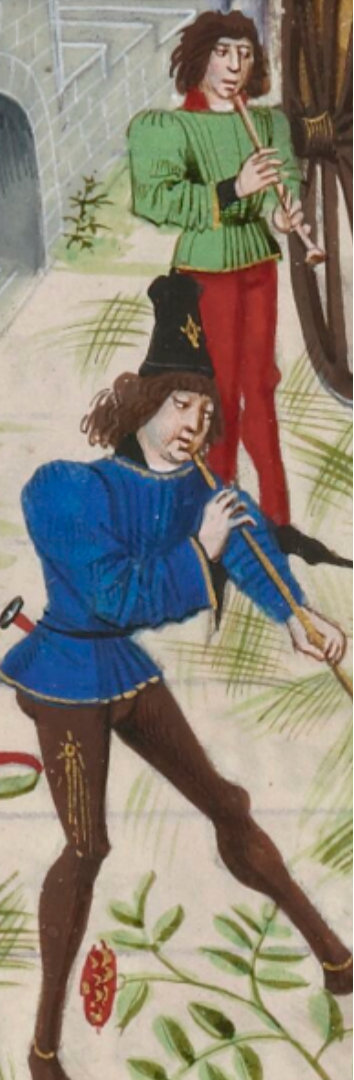
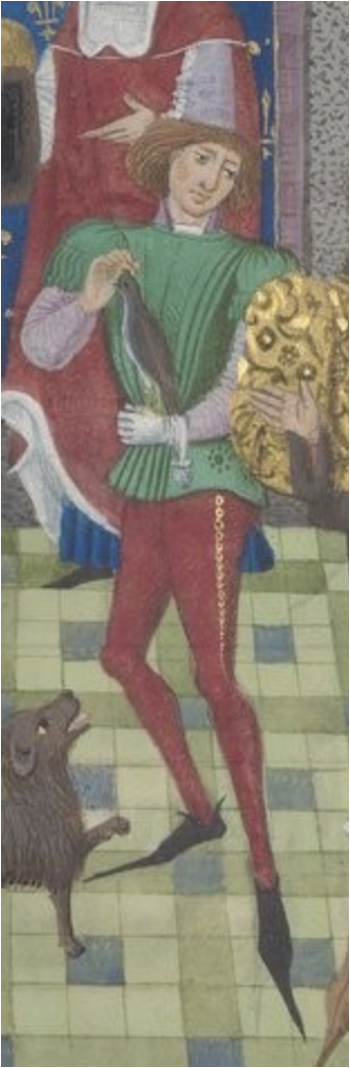
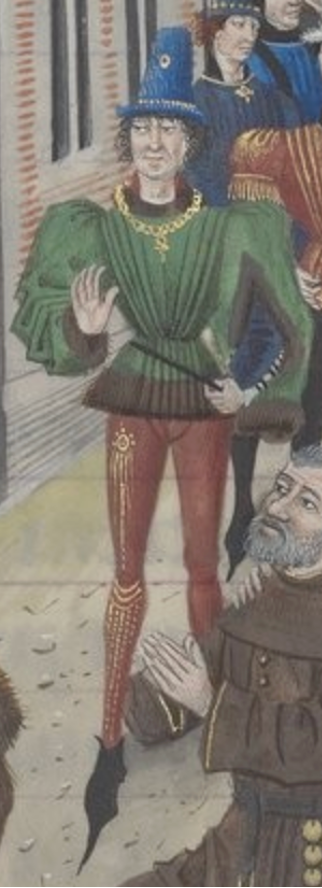
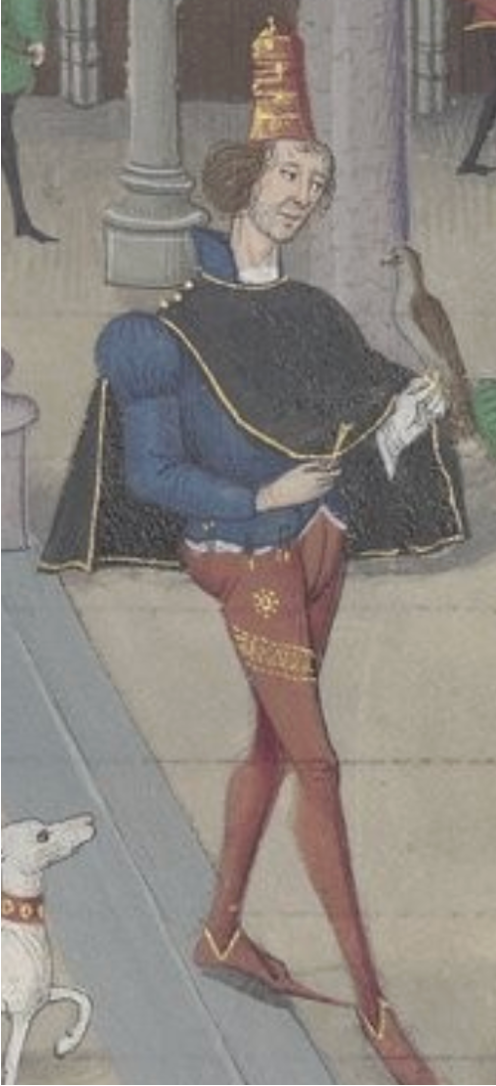
Embroidered hose in Burgundy date back to at least the early fifteenth century, with the court accounts for 1416-20 referencing two pairs of hose for the Count of Saint Pol embroidered with his device and a further five with unspecified embroidery (Mollat and Fawtier, 1965: 78-9). Philip the Good also ordered two pairs of scarlet hose embroidered with the ducal motto (‘Autre n’aurai’') in 1420-22 (Jolivet 2015). While clearly tied to embroidered ornamentation on clothing in general (for discussion of women’s embroidered sleeves, for example, see Frick 2002: 197), I couldn’t find much discussion of embroidered hose specifically in a Franco-Flemish context in secondary sources. Van Buren remarks on the mottoes embroidered on the hose of the men in the Alexander romance frontispiece (the middle tile above), but does not provide any context to this practice (2011: 208). Crane’s work, while discussing predominantly embroidered sleeves and collars when it comes to clothing, allows for the placing of it within a broader ‘hundred-year vogue for using personal mottos, signs and colours in clothing’, from about 1350 to 1450 (2002: 15).
Véniel’s Le costume médiéval links the practice of embroidering hose to courtly love, as seen in Antoine de La Sale’s 1456 romance Jehan de Saintré (2021: 102). In this novel, a widow referred to as “Madame des Belles Cousines” gives the 13-year-old protagonist a purse with some money inside, and instructs him to purchase clothes (including hose) embroidered with her colours and personal emblem. The ladies of the court (including the Madame, pretending to be none the wiser), make a game of trying to find out who his love is upon seeing his finely embroidered garments (La Sale, 2014: 58-62). Years later, when he visits her in Paris, he wears ‘scarlet hose embroidered in large, fine pearls, in Madame’s colours and device’ (2014: 189) to show her that he still cares for her.
A trend for embellished hose specifically is better documented in Italy, where it seemed to originate with elite young men in Venice, who formed social and cultural fraternities called “Compagnie della Calze” (“Companies of the Hose”), and adopted extravagant hose as part of their livery. These hose could be parti-coloured, striped, embroidered with emblems or heraldic motifs, and/or decorated with pearls and jewels (Casini 2011: 139). The fashion spread to other Italian elites, with McCall referencing metallic threads, chains and gilt brocade being applied to the hose of Nicolò d'Este, his sons, and the courtiers at Ferrara and Modena (2022: 147-8). It can also be found elsewhere in Europe, for example the elaborate crown-like band of goldwork and pearls around the calf of the recently married man in “A Bridal Couple”, a Southern German painting from c.1470 now held in the Cleveland Museum of Art.
Depictions of goldwork embroidery on hose in Burgundy and Europe more widely do therefore seem to accord with historical reality: either displaying symbols of personal identification and significance, or those associated with a lover. While only the Alexandre frontispiece clearly shows a motto and entwined initials, common motifs in illustrations seem to be diagonal bands, sunbursts and raindrops.
Decisions
Based on all this, I decided to make my hose from a medium-weight fulled black 2/2 twill, with 9 pairs of eyelets for points and lapped seams at the foot. I deliberately did not make a decision about the shape of the seat seams, because I wanted to be guided by what gave the best fit. My soles would be of the same fabric (rather than thicker, as in the Groningen finds), both to reduce bulk and because I didn’t have thicker black wool in my fabric stash. They would have the triangular cut-out sole of the Finsbury and Alpirsbach finds, so I could experiment with the effect it gave. I wanted shoes to form a part of the outfit, so decided to leave soled hose for another time. I may yet embroider them.
Bibliography
Beaulieu, M. and Baylé, J. (1956) Le Costume en Bourgogne: de Philippe le Hardi a la mort de Charles le Téméraire (1364-1477). Paris: Presses Universitaires de France.
Cassini, M. (2011) “The ‘Company of the hose’: youth and courtly culture in Europe, Italy and Venice.” Studi veneziani 62: 133-154.
Crane, S. (2002) The Performance of Self: Ritual, Clothing and Identity During the Hundred Years War. Philadelphia: University of Pennsylvania Press.
Crowfoot, E., et al. (2001) Textiles and clothing, c. 1150-1450 (second edition). Woodbridge: The Boydell Press.
Cubitt, R. S., et al. (2019) "An important 16th-century finds assemblage from ‘Moorfields’, Liverpool Street, London." Post-Medieval Archaeology 53.2: 225-265.
Fingerlin, I. (1997) “Seltene Textilien aus Kloster Alpirsbach im Nordschwarzwald”. Waffen- Und Kostümkunde 39: 99–122.
Frick, C. (2002) Dressing Renaissance Florence: Families, Fortunes and Fine Clothing. Baltimore: Johns Hopkins University Press.
Gay, V. and Stein, H. (1887) Glossaire archéologique du Moyen Age et de la Renaissance. Paris: Librairie de la société bibliographique.
Jolivet, S. (2015) “La construction d’une image : Philippe le Bon et le noir (1419-1467)” Apparence(s), 6.
La Sale, A. de et al. (2014) Jean de Saintre : A Late Medieval Education in Love and Chivalry. Philadelphia: University of Pennsylvania Press.
Malcolm-Davies, J., & Mikhaila, N. (2006) The Tudor Tailor: Reconstructing sixteenth-century dress. London: Batsford.
McCall, T. (2022) Brilliant bodies: fashioning courtly men in early Renaissance Italy. Pennsylvania: Pennsylvania State University Press.
Mollat, M. and Fawtier, R. (1965) Recueil des historiens de la France; Documents financiers vol 5: Comptes généraux de l’État bourguignon entre 1416 et 1420. Paris, Imprimerie nationale.
Origo, I. (1992) The Merchant of Prato: Francesco Di Marco Datini: Daily Life in a Medieval Italian City. London: Penguin Books.
Scott, M. (1980) The History of Dress Series: Late Gothic Europe, 1400-1500. London: Mills & Boon Ltd.
Staniland, K. (1997) “Getting there, got it: archaeological textiles and tailoring in London 1330-1580” in Gaimster, D. R. M. and Stamper, P. A. (eds.) The age of transition: the archaeology of English culture, 1400-1600. Oxford: Oxbow Books: 239-250.
Sturtewagen, I. (2016) All together respectably dressed: Fashion and clothing in Bruges during the fifteenth and sixteenth centuries. PhD Thesis, University of Antwerp, Antwerp.
Thursfield, S. (2015) Medieval Tailor’s Assistant (second edition). Ramsbury: Crowood Press.
van Buren, A. (2011) Illuminating fashion: Dress in the art of medieval France and the Netherlands, 1325-1515. New York: Morgan Library and Museum.
Véniel, F. (2021) Le costume médiéval de 1320 à 1480. Saint-Martin-des-Entrées: Editions Heimdal.
Zimmerman, H. (2004) “Sixteenth-century hose and their Manufacture”, Acta Archaeologica Lodziensia 50/1: 159-165
